

Could Advertisements Be Considered Art?
Comparing ads to traditional art (a look at history's greatest ads)

Dear reader,
Before we really start to munch on these meat ‘n potatoes, let’s start off with a swift semantic appetizer:
“ADVERTISING” is about getting eyes on a commercial message.
And advertisements, or “ads”, are the pieces deployed to do just that.
Now, while one could say that it’s an “art” to create those attention-grabbing suckers, that’s not the art I have in mind here.
The art I have in mind here is more akin to the “fine arts”.
You know, the kinda art that is… kinda useless (let’s be real). But nevertheless, a godlike luxury that inspires us and makes life more meaningful on this meaningless floating rock (without it having some practical utility – or trying to sell us some practical product or service).
… NOW before we dig in, I just want to say that, yes… I know how much we all hate ads. We skip ‘em, toss ‘em, curse ‘em, and even flip our middle fingers at ‘em. Ads are the worst. I agree.
But let’s imagine for a second: You and I are in charge of this month’s ad campaign for a biz run by a tight-fisted grouch of a boss with a stick up his ass.
Deep down, however, we are secretly undercover artists—so we can’t quell the urge to be O R I G I N A L . . .
… So together, we’d rather conspire to bring about a new high-risk, high-reward, heat-seeking marketing missile instructed by the intersection of our intuition, taste, research & knack for lateral thinking to hit the market with a beautiful buck booming bang.
To pull this off, however, we have to make it look “logical” and “smart”. God knows, the boss would rather have us play by the old book. Like always. Safe and rational. To craft another one of those cold and dry, soul-sucking, cookie-cutting lackluster little adsicles.
But we’re conniving little rebels, you and I.
… So we’re stuck with the nearly impossible challenge:
Satisfying ourselves creatively, while captivating our customers’ attention with beauty—and not having them pissed off at us, or ignoring us—but actively wanting to send us the moneys—while also pleasing our left-brained bastard boss… all at the same time.

Now that’s a challenge worthy of the Mission Impossible theme song.
We make one move too wacky and our ass is getting fired!
So how do we do this?? You ask me, now, as sweat droplets start to form.
Well let’s break this down, partner:
We’d first have to make up a spectacular offer, and write about that offer persuasively (I mean that’s what everyone with half a’ brain in business' tryna do, isn’t it?)
Secondly, we’d have to do that in a way that’s beautiful and original - at the same time (since we’re really artists, remember?)
And THIRDLY, we’d have to essentially Trojan horse that motherfucker down the canals of the campaign planning meetings and make it look super solid, OR, somehow, persuade the boss to fully trust our creative vision and leave us alone.
So our task is to somehow accomplish BOTH a successful ad campaign and a risky breathtakingly beautiful piece of art, and then walk out the front door of our office with fat sacks of cash like nothing. even. happened.
Oof..
That’s uhh…
I mean, it’s uhhh, it’s uh, yeah. I see what you mean.
Uh, lotsa risk being creative in the business space.
Takes guts.
I guess that’s why most ads we see suck.
So when an advertiser like us finally does make one of those ballsy artistic, original ads… and it SUCCEEDS because of that?
Then… what’s the difference between that, and an oil painting by some pretentious old painter? (I mean, other than the obvious fact that it’s also advertising something)…
Well it’s an interesting question. And I probably sound biased at this point to be like “advertising can be an art”. But I know you wanna see some examples, see that in action, so what we will do is, we’ll first quickly define what art is, and then, based on that — we’ll compare it to some of the most original or otherwise beautiful ads and see if they align. So buckle up, buddy. It’ll be fun.
Art—as I define it, follows 4 criteria:
It’s something that can be seen as beautiful.
It can cause a meaningful aesthetic emotional reaction.
It has the power to change how something is perceived.
It has some level of inherent value (despite having little or no functional use).
And yes, I understand that—what is art and what’s not—what’s beautiful and what is ugly, is entirely in the eyes of the beholder.
But for the purpose of this discussion, let’s just agree on the 4 qualities above—so that we can compare them with a few banger advertisements, and see if they hold up.
If an ad does happen to check off these 4 boxes—could the ad then be considered a piece of art, like the Mona Lisa?
… Now, as I said, we all unanimously agree most ads are pretty damn fucking ugly, annoying and uncreative (AKA: not art)
But, that’s not what I’m concerned with here. What I’m concerned with is the outliers.
To be clear, what I’m talking about is:
The ones that were beautiful and emotionally impactful despite being an advertisement.
The ads that were approached more like “art” than “craft”.
The ads that were original…
The difference between art and craft being that 'art is original creation whereas craft is carrying out an instruction, following a convention or employing a technique' (Telfer 15).
Because advertising in general is undoubtedly more of a “craft” than an art; the field of advertising is mostly “scientific”; it’s about following the research, the templates, rules, formulas, frameworks — just like a chemist in a lab, mixing elements to produce a compound.
But as we shall see—there are examples in history where certain ads were approached more like art—despite being bloody advertisements. Ads that were probably, most likely, created by closeted artists. These ads were also lucrative, leaving the brass tacks boss satisfied and smiling.
So if advertisers in the past have indeed benefitted from being original, irrational, risk-taking and artsy in their approach… then perhaps they could be seen as artists in the proper sense of the word… the artists of commerce… and their ads worthy of walls at some museums.
That’s basically my premise here.
So let’s dive in.
Is Making Advertisements Really An Artform?
Number one:
“Something that can be seen as beautiful.”
1. Can Advertisements Be Beautiful?
A good ad doesn’t need to be aesthetically pleasing or beautiful to be successful.
And most of us would agree that the ads we see everyday. And have seen in the past. Are not very beautiful or aesthetically pleasing at all. They’re just there to sell something and that’s it.
Funnily enough, there’s even those in the ad industry who agree with me on this. Take the words of Rory Sutherland, vice chairman of one of the largest ad agencies in the world, Ogilvy.
In his words, it is indeed “absurdly rare” to see an ad that stands out to him as:
It’s interesting that even a guy passionate about marketing, who’s worked in the field his whole life, feels like there’s not a lot of love going into advertisements these days.
So, let’s rewind the tape, and go way back in history to a place where the advertisements were basically pieces of art entirely on their own…
Take this ad from Paris in the late 19th hundreds, made by illustrator artist Toulouse-Lautrec:
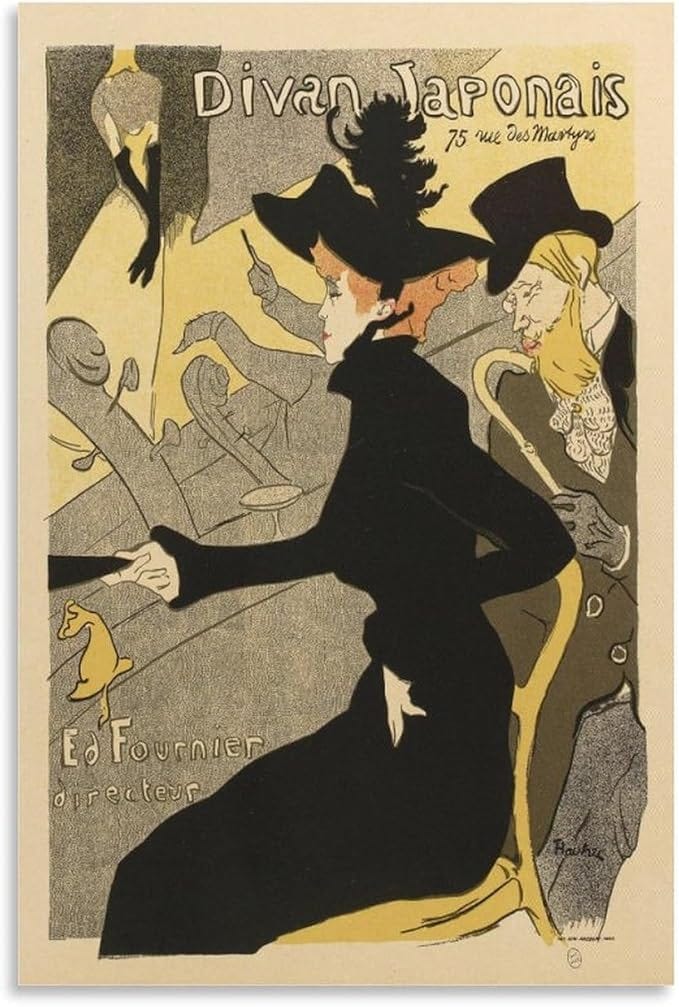
This poster was made to advertise an event.
But people to this day think they’re sort of beautiful — as reprints are still being sold, long after these ads have expired.
As an aside: in this milieu (of going to a dance hall) these genuine, aesthetic posters were probably more effective at driving people in—than a plain white sign with the text “Dance hall at this location. Come!”. So, from an advertising perspective—making it “more beautiful” would make more sense in this context—as it’s likely to be more persuasive to people who goes to dance halls in the first place.
Disregarding the fact these posters have some historical significance now, I think this is a superb example of fine art living in harmony with advertising for its time. Indeed the ad itself became considered a true piece of art with time. This ad was approached artistically without sacrificing its purpose of advertising for the event. Muah! *gestures a chef’s kiss*
Conclusion:
This ad was made in good taste by an artist and was approached artistically. Many people expressed they perceived these ads to be beautiful as reprints are still being sold to this day. Thus, it should technically fulfill the criteria of traditional art, despite being an ad.
Number 2.
2. Can Ads Cause Aesthetic Emotional Reactions?
Just as true art is useless if it doesn’t make you feel anything at all, the same is true with advertisements.
Because it is famously said in marketing that:
People buy based on emotion, and justify with logic.
Ever heard that? Well, it’s a truism stated in the trusty salesman’s handbook. Emotions rule the world of commerce, too. Not just art.
(btw, this is why so many ads are using art, to evoke specific emotional reactions in the viewer. Whether it be through music, videos, images or creative writing. more on this later.)
Let’s have a look at an ad campaign that was produced almost entirely artistically.
Interestingly, for a bank.
Hal Riney’s Bank Ad To Attract Younger Customers:
(From the documentary “Art & Copy”, 2009)
This commercial was made for a bank struggling to sign up younger clients.
So the creative director at the agency suggested to hire a songwriter. Then based on the song that was produced, he would go on to direct the commercial for it.
Now what’s so interesting is that no words are used in the commercial—except one tag line at the end. This was original for its time because no one else was doing that in the late 60s.
So, it’s pretty much just an aesthetic music video that happens to sell you on a bank subscription.
There’s no cheap tricks or sleazy selling going on here.
The ad man “broke the rules like an artist”, if you will.
That takes boldness and original action-taking.
In other words, this ad wasn’t successful because they plugged & played a tried & true persuasion formula or something of that kind. Because it was unconventional and beautiful, it was successful.
More importantly though—it brought more sign ups for the bank because the music and scenery connected emotionally with the audience—precisely just like any good piece of art does.
Difference being, this artistic video was also advertising for a bank at the same time as it was providing us with a beautiful aesthetic emotional experience. And it could just as well have been the official music video for that song.
Of course, traditional art by itself wouldn’t sell you on anything other than into the emotional experience itself, to provide you with a moment of beauty—so that you might invest in the others works of the particular artist—and pay for the ticket fees to their future exhibitions, or events, or whatever the case may be.
Conclusion:
This commercial was approached artistically and not “scientifically”, and thus gave the audience a true aesthetic emotional experience just like a piece of traditional art does. It was original and took risk. It seems to fulfill the artistic criteria and it also serves its purpose as an ad. Badabing badaboom.
To me, this is a sublime example of art as advertisement.
This commercial is, in my humble opinion, a piece of art.
Number 3.
3. Does Advertising Change How We Perceive Reality?
Art, as we all know, changes how we perceive a situation by making us notice and feel things we might not otherwise have noticed or felt.
For example:
Vibrant colors tells you one thing, black and white a different.
Same with the use of major and minor chords in music.
Or let’s say, a film-maker chooses to focus on the hard upbringing of a problematic character, positioning him as the victim of a tough time—with some sad music along with it. This makes us, the audience, more empathetic towards him. Whereas if the same story was told—but only focusing on the bad things the person did, we wouldn’t feel so favorable to him.
Artists are magicians, they have the power to change how reality is perceived.
The same framing technique is also used by advertisers.
Take this famous example of a brilliant ad from 1962:
“We’re number two, so we try harder”.
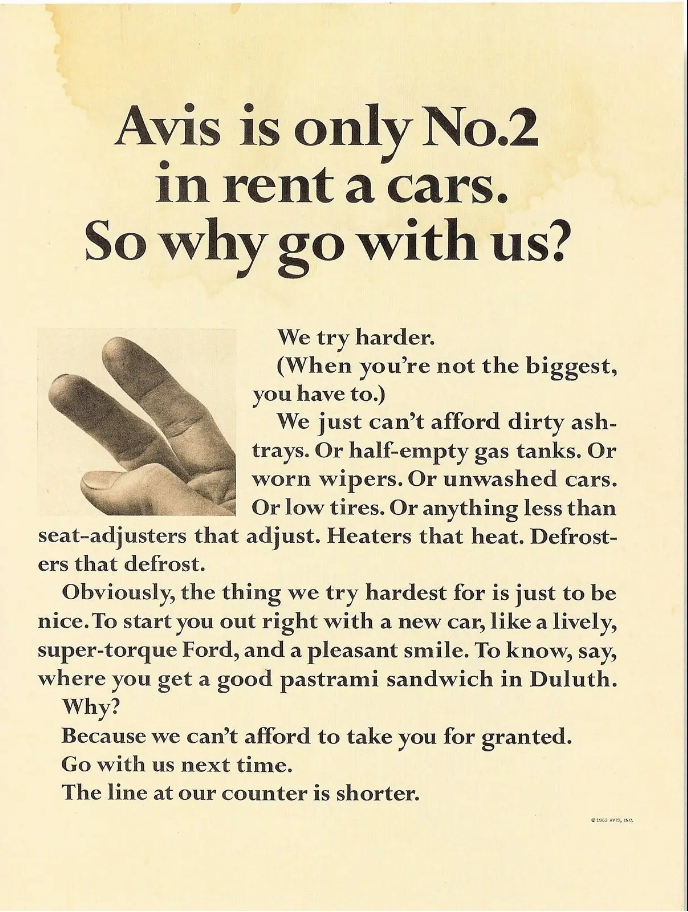
With this ad campaign — they turned a weakness into a strength; by changing our perception on what being number two really means.
That’s elegant.
A great ad that apparently ran for 50 years.
… But is it “artistic” like a piece of art, in any way?
Well, the idea here is certainly creative.
And it’s also original, I believe.
… Some interesting pics along with it, too.
And uh, the headline here positions themselves as “Only No.2”, and then, in just a few words described how that’s a good thing… which changes our perception.
Very impressive. They couldn’t just have come up with that by simply following a formula or filling out a template.
But is that enough to make these specific ads “art” or not?
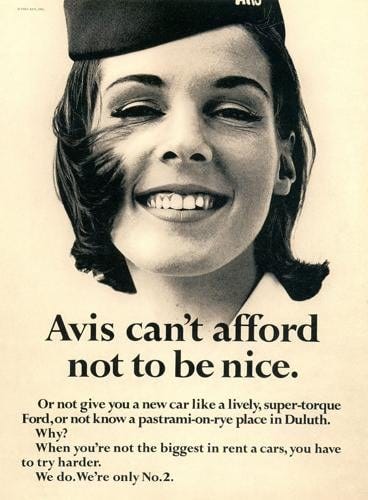
As we defined earlier: art as opposed to craft, is when it’s original, beautiful, causes an emotional impact and has some inherent value.
I’m not sure if their ads are “beautiful”, or creates an emotional reaction, other than selling more for the company and gives the average person an interesting ad to read. I personally like the text and the images. It has some soul to it. But that’s just my opinion.
It is nonetheless a highly clever positioning that changes our perception—just the way any good piece of art does. That’s the main similarity in this case.
… And as we've said, many advertisements use art in order to do this:
Most commercials have some sort of feel-good music in them. This is so we’ll unconsciously associate good emotions with their brand, making us more likely to buy from them in the future. But the fact that those commercials use feel-good music as a tool to sell doesn’t make the commercial itself art though (even if the song is considered art on its own). That’s an important distinction here.
It’s the fine touch of a bold artist that would make it art—as anyone could slap together some pleasing sounds and colours, especially these days.
These ads above, “Only No.2”—used images and creative writing to make a persuasive point in an original way, and it felt sincere, like perhaps some love and care actually went into crafting the ad.
So, make of that what you will.
Personally, I do think these ads are beautiful since I love creative copywriting and consider it as a sort of art form. Although most people would probably not go that far.
Conclusion:
Viewing this from the eyes of business & advertising, this is art.
But switching it 180 degrees, and seeing it strictly from the lens of traditional art… Not necessarily so.
For this to satisfy the criteria of art from both sides, the advertisement needs to provide a somewhat original aesthetic emotional experience, be beautiful, while changing our perception of the thing… and have some inherent value. Which I suppose this one doesn’t have to people who don’t care about creative copywriting. Ultimately, this ad could only be “art” to a few people. Which, when you think about it, is true of a lot of art. Lot of weird niche art out there.
So it’s how the advertisers use this magic and how it is then perceived that decides if it could be deemed art or not. Since I perceived this ad as a piece of art (and wouldn’t mind hanging it on my wall), it is art… to me. But in a wider sense, probably not.
Okay, last one!
4. Does Advertisements Have Inherent Value?
Not really, no.
I think we all agree that it’s not the case for the vast majority of ads; it’s extremely rare.
Most ads have no real value beyond being a mere sign post for people to buy something at a certain price.
Even influential people in the industry agrees that most ads are crap:
“Trash, trash, trash!
That’s how I describe 99 percent of today’s advertising.
It’s dumb. Boring. Weak. Not worth the paper it’s printed on.
Am I angry? No.
Realistic? Yes.
But don’t just take my word for it.
Look in your trash can.“
— Drew Whitman (Ca$hvertising)
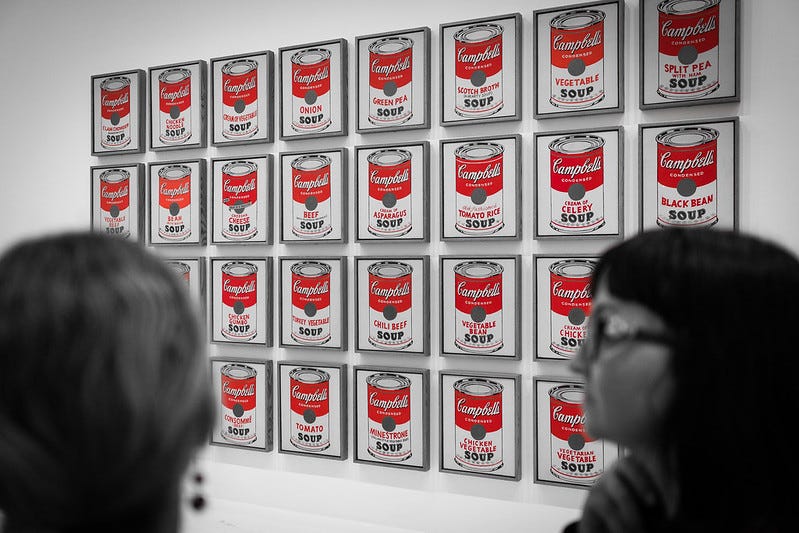
If ads did have some inherent [artistic] value, we’d hang some of those ads on the walls as posters. Something I have never seen… (except for those cool vintage ones, or like that Andy Warhol Campbell Soup can).
However, one interesting example from recent days was an ad by the car company Nissan, where they reproduced the “lo-fi girl” YouTube video format that has been so popular over the past few years.
So, here the ad is a 4-hour music playlist with an animated cartoon of a girl driving Nissan’s new car, ARIYA—and in the background, we see her driving past Nissan billboards.
But it’s really just a video that plays smooth lo-fi hip hop instrumentals. But because of the art, the music, the cartoon—people want to watch and listen to it because it has some inherent value. It looks pretty, it’s entertaining, and gives us an aesthetic emotional experience.
So it’s not just an ad that says “BUY NISSAN NEW CAR”—instead, it’s aesthetic, it plays good music—which happens to be an ad for Nissan at the same time.
Is that art… or just artful?
Whoever made this ad must have been rather creative at the least. They didn’t reproduce the same ol’ boring car commercial format like every other car company. The format itself, of course, is not original, but using it as a commercial is (as far as I’m aware).
And if you scroll down, and check the comments of that video, people are genuinely happy and expressing that this is a great ad.

It made Nissan a more liked company as a result, and out of those 18 million views—some of them probably bought a Nissan ARIYA too.
Interestingly, I asked people on Threads if making a playlist is an art form, and about 90% of them said yes.
Anyway, this modern ad pretty much fulfills the 4 criteria of art: it’s beautiful, changes our perception of something (Nissan), provides an emotional experience and has inherent value as an aesthetic video music playlist that you can replay however much you like for your own amusement.
The thing, though, is that if other car companies straight up copied this format without adding any new twist to it, it wouldn’t be art anymore, but a craft. Since now anybody could hire someone on Fiverr to animate a video and anyone could put together a series of nice royalty free beats as a playlist. (Unless, perhaps, they made some real bangers with novel lyrics that are amazing on their own, that also serve as copywriting for their product. And maybe a silly little dance along with it too because why not. That would be new.)
Again: it’s the execution of an original artistic idea that make it art, as opposed to craft.
So, could certain advertisements actually be considered true art?
As I hinted to earlier, my answer is… Sometimes.
… As long as it’s:
approached artistically
somewhat original
gives us an aesthetic experience
changes our perception
is beautiful
has inherent value
Then yes. By all outward appearance, it’s art.
… So final conclusion: if an ad is produced artistically, creatively, and is sorta original and fulfills the 4 criteria, it could be considered as art.
And what’s more, such ads have been successfully produced in the past—which proves that the expression of true art has a place in the business world too.
However, nearly every ad ever been made does not fulfill these criteria, which makes the field of advertising a craft, and not an art form. And thus, one can not say that “ads are art”.
But one could perhaps say that the field of advertising is a “psychology-informed science fueled by creative problem solving with sporadic hints of true art”.
Because it is indeed very rare for an ad to be considered art by itself.
So when it is art, it tends to really stand out, be more remarkable and memorable… (which is the dream outcome of advertising).
So perhaps in the growing noise of lackluster market homogenization where we ignore ads by instinct, the true artist could be a company’s last hope.
What do you think?
Let me know in the comments.
Thank you for reading.
Stay sassy,
Robin Mo
PS.
If you liked this one, and want to read more about my adventurous meanderings through the wonderous world of art & advertising — subscribe for free, or pledge me the price of a fancy coffee (I ♡ coffee):
The very best ads are the ones we remember.
They made us laugh, they made us smile, they made us stop, they made us feel.
Just like I showed you earlier with Toulouse-Lautrec, the French illustrator whose ads could be considered pieces of art by themselves, still being sold to this day. Or the cinematic commercial by Hal Riney’s, which holds up as its own—despite its purpose to drive more people to sign up for their bank.
Advertisements can exist in the world, and it can be beautiful.
One may say that ads are “art for capitalism”, and yeah that’s true, but since most of us live in capitalistic systems—why can’t we, as artists, advertise for companies we believe in through our art—and contribute to society by making those ads more beautiful?
We can harmonize art & advertising, just like Hal Riney did back in 1970 with the commercial he directed after hiring the songwriter Paul Williams to make that ad for that bank corporation.
The very best of ads can be seen as pieces of art—and advertising is overall most effective when using some form of art to convey its message. Art & advertising goes together well like peanut butter and chocolate.